
Key takeaways
- Price range: business email costs about $1.25 to $22 per user per month on the main plans, with email-only plans at the low end.
- Three tiers: entry-level email (Neo Mail, Fastmail) costs $1 to $5. Suites (Google Workspace, Microsoft 365) cost $7 to $22, and premium support (Rackspace Email) starts at $10.
- What drives the price: the number of mailboxes, storage, billing term, included apps, support level, domain and add-ons.
- Billing terms matter: yearly and multi-year plans cost less per month than monthly billing, and renewal prices can rise, as Microsoft’s did in July 2026.
- Yearly bill for five people: the starting plans range from $75 to $600 a year, before domain and add-on costs.
How much does business email cost by tier?
Business email pricing falls into three tiers, and the tier you need sets most of your bill.
Entry-level email suits solo founders and small teams that mainly send and receive mail. A productivity suite makes sense when your team shares files and meets online every day. Premium support plans cost more per mailbox, but they suit businesses that want a real person to call when something breaks.
What changes the price of business email?
The price of business email changes with seven things, and most of them multiply as your team grows:
- Number of mailboxes: most providers charge per user or per mailbox, so five people cost five times as much.
- Storage per user: bigger mailboxes and file storage sit on higher plans.
- Billing term: yearly and multi-year plans cost less per month than monthly billing.
- Apps included: email-only plans cost less than suites with documents and video meetings.
- Support level: round-the-clock human support usually costs more.
- Domain: you need a domain like yourbusiness.com, that most providers help you create business email without domain.
- Add-ons: archiving, extra storage and AI tools can add to the base price.
How do billing terms and renewals change what you pay?
- Longer terms cost less: paying yearly or for several years upfront is usually cheaper per month than paying month to month.
- Example: Google Workspace Business Starter costs $7 a month on the Annual Plan, against $8.40 on the Flexible Plan.
- Deals end at renewal: long-term discounts often cover only the first term, so the price can rise when you renew.
- Prices go up over time: Microsoft raised Business Basic from $6.00 to $7.00 on July 1, 2026, according to Microsoft’s pricing update.
- Before you pay: check the renewal price, not just the first-term price.
How did we check these prices?
We checked each provider's official US pricing pages, Google's help center and Microsoft's pricing announcement in October 2026. Every price in this guide is in US dollars before tax. We recorded the same details for every provider: the price per user or mailbox, the billing term, storage and the free trial. Where a page listed several billing terms, we show each one. No provider paid to be included, and we list each provider's limits alongside its strengths.
How do business email prices compare across providers?
The table below starts with Neo Mail, our pick for small businesses, then lists the other four alphabetically.
Prices checked October 2026 on each provider's official US pages.
What does best business email provider charge?
Each provider below lists its plans and US prices as bullet points, followed by pros and cons. Neo Mail comes first as our pick for small businesses, and the rest follow alphabetically.
1. Neo Mail: best for getting email, a domain and a website in one plan
Best for: small teams that want a low monthly price and a free domain.
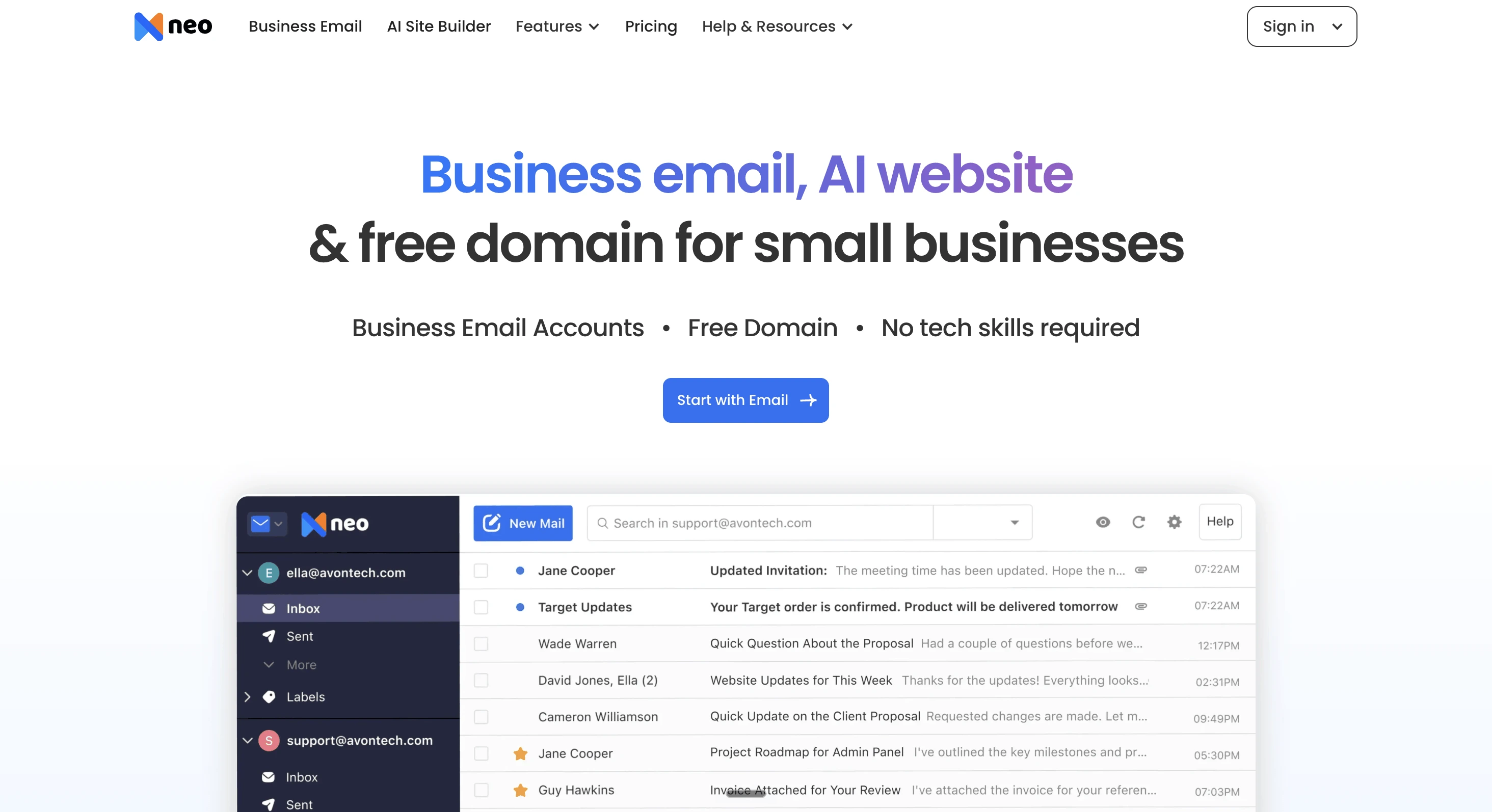
Neo Mail is a simple, affordable business email made for small teams. It suits business owners who want a professional address and an easy-to-use inbox, without paying for a full office suite.
Plans and prices
- Starter: $1.25 per mailbox per month on the 4-yearly plan ($1.49 two-yearly, $1.99 yearly, $2.49 monthly).
- Standard: $2.49 on the 4-yearly plan ($2.99 two-yearly, $3.99 yearly, $4.99 monthly).
- Max: $4.99 on the 4-yearly plan ($5.99 two-yearly, $7.99 yearly, $9.99 monthly).
- Free trial: 15 days.
Pros
- Free domain with every plan
- Free AI website builder
- 15-day free trial
- Built-in calendar and apps for all devices
- Read receipts on every plan
- Priority Inbox, Send Later and Undo Send from Standard up
- AI Email Writer, appointment booking and Email Backup on Max
- Two-factor authentication, anti-spam and antivirus protection
Cons
- Starter caps sending at 500 emails a day
- No document or spreadsheet editors
2. Fastmail: best for independent email with long-term discounts
Best for: small teams that want fast email, calendar and contacts without a suite.
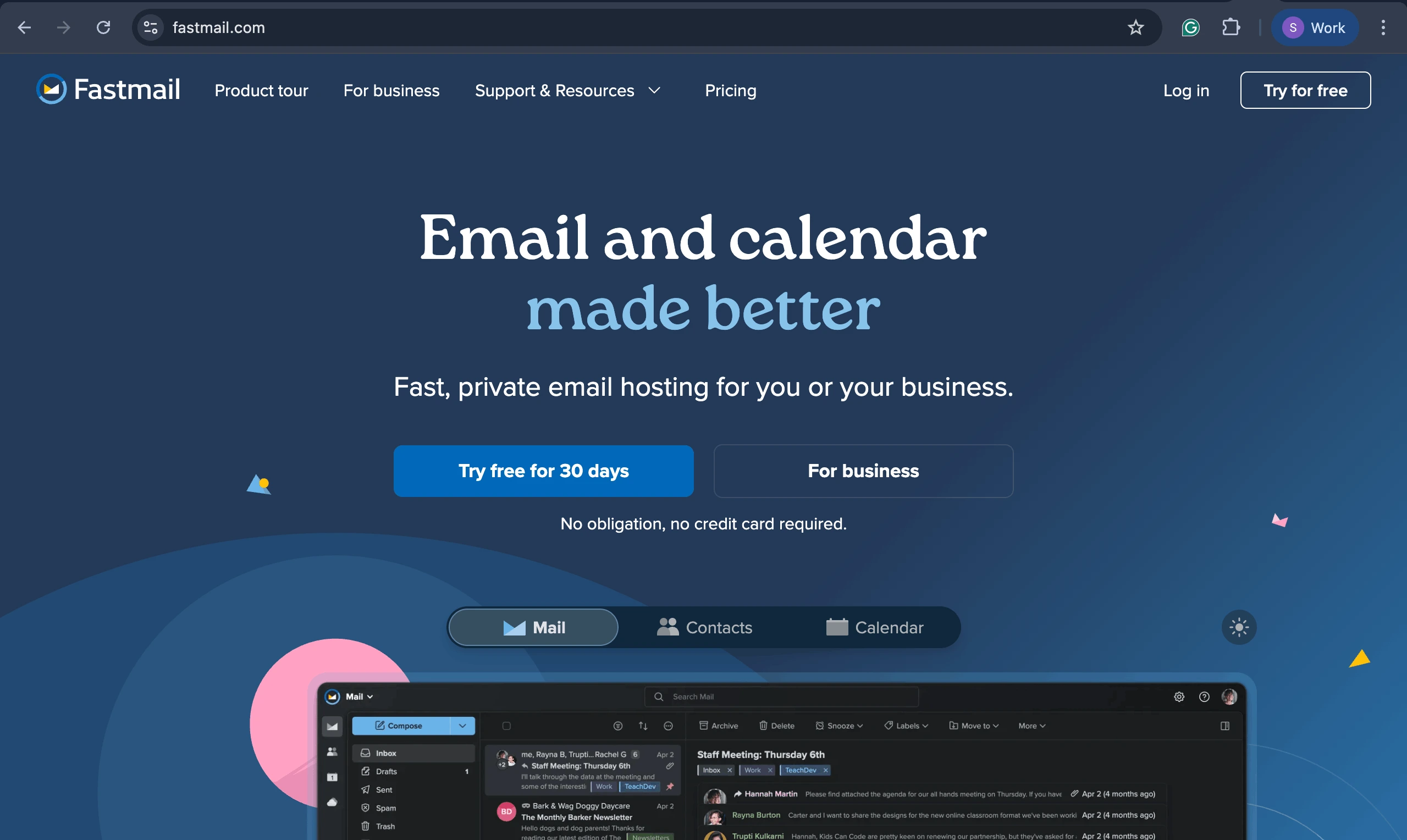
Fastmail is an independent provider that focuses on email. It offers 24/7 support from real people and works with apps like Outlook and iPhone Mail.
Plans and prices
- Basic: $3 per user per month on a yearly plan ($4 monthly), with 6 GB of storage per user.
- Standard: $5 per user per month on a yearly plan ($6 monthly), with 60 GB per user and addresses on your own domain.
- Professional: $9 per user per month on a yearly plan ($10 monthly), with 150 GB per user and email retention.
- Free trial: up to 30 days.
Pros
- Lower monthly price on 24- and 36-month terms
- 24/7 human support
- Works with standard mail apps
- Free trial of up to 30 days
- Shared addresses like support@yourbusiness.com on every plan
- Shared calendars and a shared company address book
- Robust encryption to keep email private
- Scheduled Send and Snooze from Standard up
Cons
- No documents or video meetings
- Custom domain addresses are listed from Standard up
3. Google Workspace: best for teams that want a full suite
Best for: teams that share files and meet online every day.
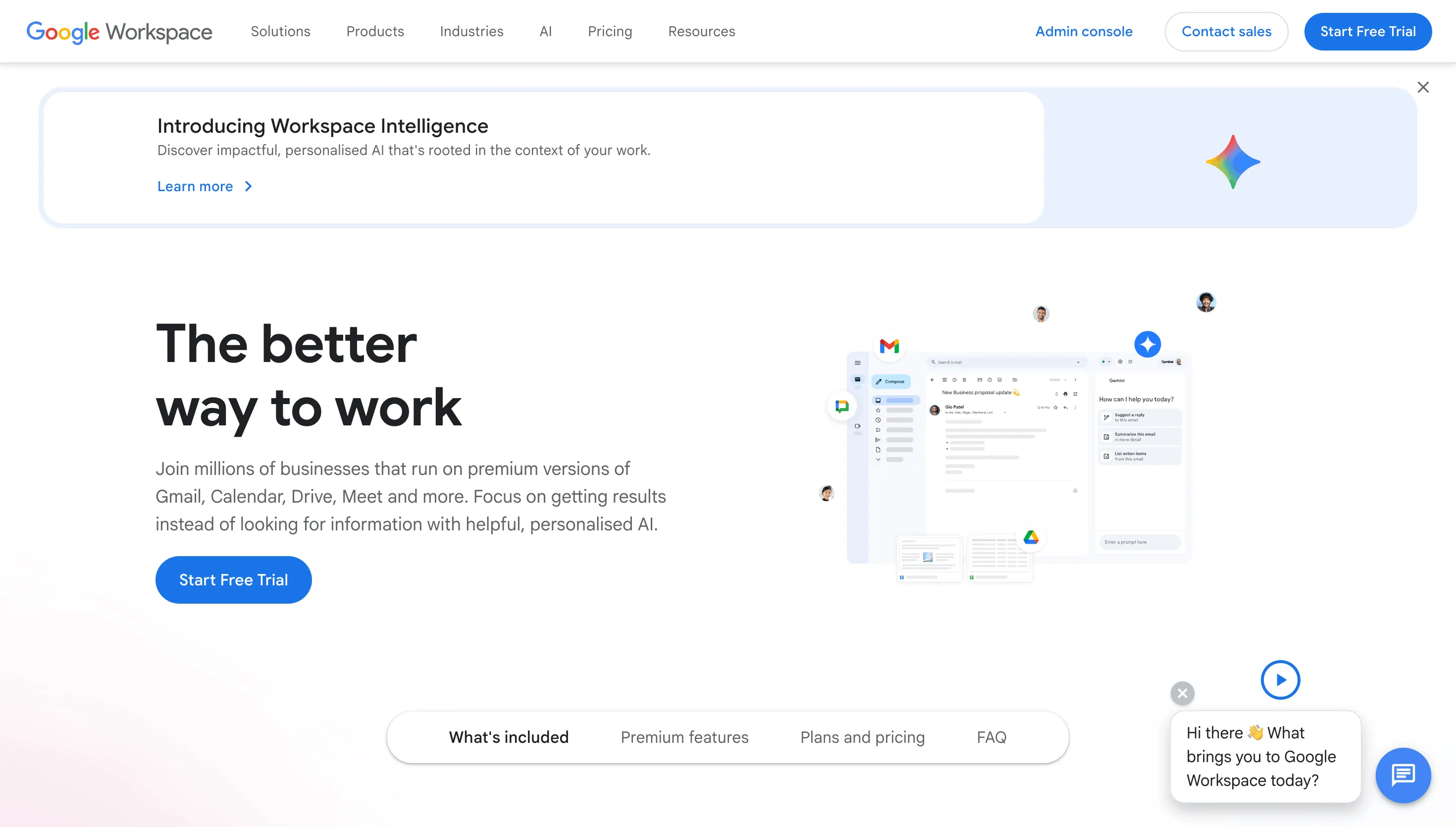
Google Workspace pairs business Gmail with Docs, Drive and Meet. Its three Business plans differ mainly in storage and meeting features.
Plans and prices
- Business Starter: $7 per user per month on the Annual Plan, or $8.40 on the Flexible Plan, with 30 GB of pooled storage per user.
- Business Standard: $14 per user per month on the Annual Plan, or $16.80 on the Flexible Plan, with 2 TB of pooled storage per user.
- Business Plus: $22 per user per month on the Annual Plan, or $26.40 on the Flexible Plan, with 5 TB of pooled storage per user.
- Free trial: 14 days.
Pros
- Documents, storage and video meetings included
- A clear choice between flexible and annual billing
- 14-day free trial
- Gemini AI included in Business plans
- 99.9% monthly uptime promise in Google’s service level agreement
- Familiar Gmail inbox, so there’s little to learn
- Appointment booking pages and eSignature from Business Standard up
Cons
- Starter storage is only 30 GB pooled per user
- The Flexible Plan costs 20% more than the Annual Plan
4. Microsoft 365: best for Outlook users and email-only plans from a major suite
Best for: teams that work in Outlook, Excel and Teams.
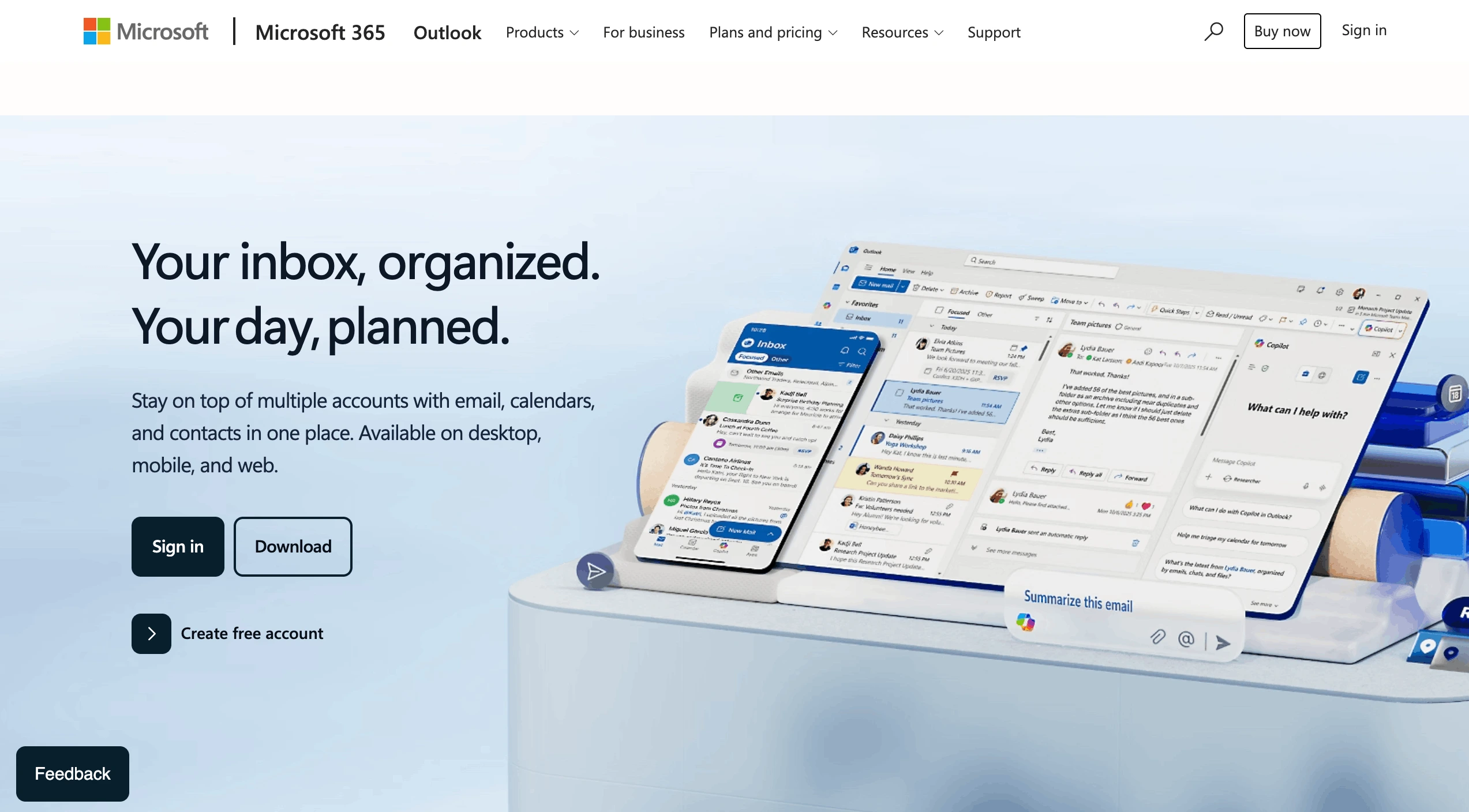
Microsoft 365 business plans include Outlook and Teams, and Microsoft also sells email-only Exchange Online plans. Prices rose on July 1, 2026.
Plans and prices
- Business Basic: $7.00 per user per month, paid yearly, with web and mobile apps and a 100 GB mailbox, on Microsoft's business plans page.
- Business Standard: $14.00 per user per month on an annual subscription. The plans page now leads with Business Standard with Copilot at $23.50, paid yearly.
- Business Premium: $22.00 per user per month on an annual subscription. The plans page shows Business Premium with Copilot at $32.00, paid yearly.
- Email only: Exchange Online Plan 1 costs $4.00 per user per month, paid yearly, with a 50 GB mailbox, on Microsoft's Exchange Online page.
Pros
- The cheapest email-only plan from a major suite
- Outlook and Teams on every Business plan
- 100 GB mailbox plus 50 GB of archive storage on Business plans
- 1 TB of OneDrive cloud storage per user
- Room to grow, with up to 300 users on Business plans
- Desktop Office apps on up to 5 PCs or Macs per user from Business Standard up
- Free trial on Business Basic
Cons
- Prices rose on July 1, 2026
- Annual subscriptions renew automatically
5. Rackspace Email: best for month-to-month billing with human support
Best for: businesses that want help from a real person and no long contract.
Rackspace Email is backed by the company's Fanatical Support team. You can cancel or change your plan at any time.
Plans and prices
- Standard mailbox: $10 per mailbox per month on a monthly commitment, on Rackspace's email page.
- Plus add-on: $2 more per mailbox per month for file storage, mobile sync and Office-compatible apps.
- Archiving add-on: $6 more per mailbox per month for unlimited archive storage.
- Free trial: 14 days.
Pros
- No long-term contract
- Real human support
- No ads or data mining
- 14-day free trial
- Works across Outlook, webmail and mobile
- Plus add-on brings file storage, mobile sync and Office-compatible apps
- Unlimited archive storage with the Archiving add-on
- Option to move up to Hosted Microsoft Exchange later
Cons
- The highest starting price in this guide
- Add-ons raise the cost per mailbox
What will your business email cost per year for top 5 providers?
Your yearly business email cost is the monthly price × 12 months × the number of mailboxes. Here is the math for each provider’s starting plan, using the prices above:
For a team of five, that range runs from $75 to $600 a year before any add-ons. The gap widens quickly as you add people, so the per-mailbox price matters most for growing teams.
How much can you save?
- Email only: for a team of five, Neo Mail Starter on the 4-yearly plan costs $345 a year less than Google Workspace or Microsoft 365 (420 − $75 = $345). Fastmail Standard saves $120 a year against the same suites (420 − $300 = $120).
- Email-only plan from a big brand: Microsoft’s Exchange Online Plan 1 saves a year for five people compared with Business Basic (420 − $240 = $180).
- Suite:
- For a team of five, paying for Google Workspace yearly instead of month to month saves 84ayear(8.40 × 12 × 5 = $504, and $504 − $420 = $84).
- Choosing Business Starter or Business Basic instead of the Standard plans saves 420ayear(14 × 12 × 5 = $840, and $840 − $420 = $420), if you can live without the extra storage and features.
For a team of five, that range runs from $75 to $600 a year before any add-ons. The gap widens quickly as you add people, so the per-mailbox price matters most for growing teams.
What hidden costs should you budget for?
Hidden business email costs usually come from the domain, add-ons and switching. Plan for these before you sign up:
- Domain: the wholesale price of a .com rises from $10.26 to $10.97 a year on November 1, 2026, according to Domain Name Wire. Registrars add their own margin, and Neo Mail includes a free domain if you need one.
- Add-ons: archiving, extra storage and AI tools often cost extra, like Rackspace's $6 archiving add-on.
- Desktop apps: suites may charge more for full desktop apps, such as Microsoft's Copilot bundles.
- Migration: moving old mail takes time, and some businesses pay for help.
Is paying for business email worth it?
Paying for business email is worth it for most businesses that email customers. A paid plan gives you an address on your own domain, better spam and phishing protection, storage and support. Email fraud is costly: business email compromise cost US victims $3,046,598,558 in 2025, according to the FBI's 2025 Internet Crime Report. Light users don't need a suite, though. A small business owner on r/smallbusiness said suites seemed "expensive since I won't be using the email address much", which is exactly what entry-level plans are for.
Frequently asked questions
How much does a business email address cost?
A business email address usually costs $1 to $5 per month for email only, or $7 to $22 per user per month if you want a full suite with documents and video calls. The final price depends on how many mailboxes you need and how long you sign up for. Paying yearly or for several years upfront usually costs less.
Is business email free?
No, a business email on your own domain is usually paid. Free email services like Gmail give you an address such as yourname@gmail.com, not one with your business name. Most paid providers offer a free trial, though, so you can test before paying. Neo Mail offers 15 days, Google Workspace 14 days and Fastmail up to 30 days.
Is business email cheaper if I pay yearly?
Yes. Most providers charge less per month when you pay for a year or more upfront. For example, Fastmail Standard costs $6 per user per month billed monthly, but $5 on a yearly plan. Just check the renewal price, because some long-term discounts only apply to the first term.
How much does a domain and business email cost together?
A domain and business email together cost the mailbox price plus the domain fee. A .com domain costs at least $10.97 a year at wholesale from November 1, 2026, and registrars add their own margin. Some providers, such as Neo Mail, include a free domain with every plan, which removes that extra cost.
How much does it cost to send 10,000 emails?
Business email isn’t built for sending 10,000 emails at once. For newsletters or large campaigns, you’ll need a separate email marketing tool, which is priced by the number of contacts or emails sent.
Is hosting your own email worth it?
No, not for most small businesses. Running your own mail server saves on monthly fees, but you take on security updates, spam filtering, uptime and making sure your emails reach the inbox. For most teams, the time and risk cost more than a paid plan at a few dollars per mailbox.